biotique Bhringhraj oil

Sunday, 11 March 2018

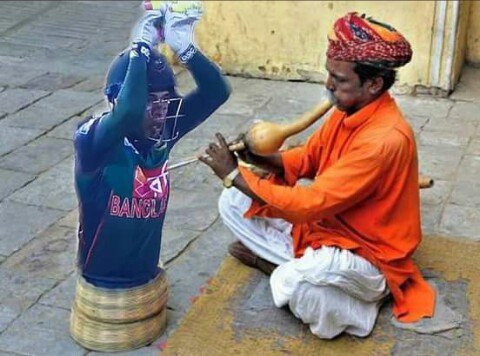
SL vs BAN: Mushfiqur Rahim does a ‘Naagin dance’ and it’s raining memes on Twitter

Bangladesh's Mushfiqur Rahim broke into an impromptu naagin dance on the field after defeating Sri Lanka in the Nidahas Trophy match and Tweeple couldn't stop laughing. Soon, his quirky moves led to a meme war on Twitter.


mushfiqur rahim, mushfiqur rahim dance, naagin dance, mushfiqur rahim memes, mushfiqur rahim dance jokes, mushfiqur rahim nagin memes, cobra dance, bangladesh vs sri lanka, sri lanka vs bangladesh, sl vs ban, nidahas trophy, cricket news

When it comes to cricket, it not just spectacular catches or wickets and historical feats that catches the attention of sports lover. Many a time, expressions and celebrations of cricketers garner a lot of attention as well; and when it’s meme-worthy, you can’t really blame them. So, when Bangladesh’s star player Mushfiqur Rahim broke into an impromptu naagindance on the field, cricket lovers and Tweeple following the match were left in splits. Rahim could not control his emotions after hitting the winning runs against Sri Lanka, helping his team chase down a record 215 runs. In in the moment, the exuberant player showed off some of his quirky moves and it was enough to light up the micro-blogging site.
Soon, not only videos of his snake-style dance went viral, with hundreds retweeting and liking it, but it was turned into a meme as well. Indian Twitterati, in particular, couldn’t keep calm and started sharing photos of television’s favourite naaginplayed by Mouni Roy, and couldn’t decide who did it better.
Sample these:

And, in case you are wondering what led to this spontaneous celebration, turns out there’s a back story too. During the press conference later, Tamim Iqbal said that the celebration style actually originated from a fellow Bangladesh player Nazmul Islam Opu. “We have a left arm spinner in Nazmul Islam Opu and it is his celebration. Whenever he gets a wicket, in domestic cricket or Bangladesh Premier League (BPL), he does this snake dance. It was quite funny. I think Mushfaqir Rahim showed it to him and we knew who he was doing the celebration for. We take a lot of pride in playing with Opu and whenever he takes a wicket, we enjoy it a lot,” said Tamim. “Unfortunately he hasn’t taken a wicket yet so when he does, you will get to see how he dances,” he added.


Saturday, 10 March 2018

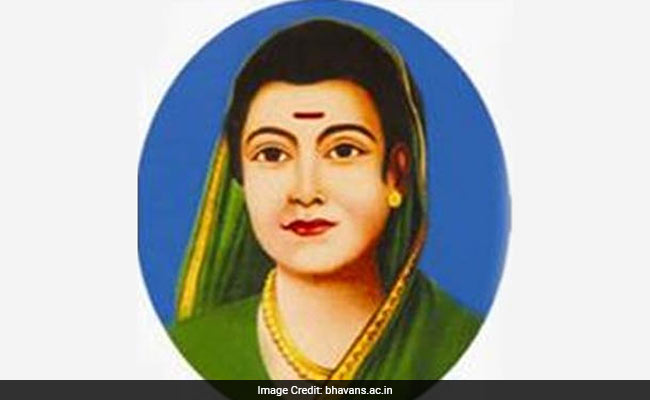
Remembering Savitribai Phule, First Female School Teacher In India, On Her 121st Death Anniversary

Remembering Savitribai Phule, First Female School Teacher In India, On Her 121st Death Anniversary


NEW DELHI:  Today is the 121st death anniversary of Savitribai Phule. Savitribai Phule is often considered the first female school teacher in India. She was married when still a child of nine to Jyotirao Phule. Both Jyotirao Phule and Savitribai Phule founded the first girl's school in Pune which was run by native Indians. She also worked alongside her husband to abolish discrimination based on caste and gender in the Indian society.


Jyotirao Phule was an advocate of female education and helped his wife attain good education against all odds. She not only became the first female teacher in the country but went on to set up 17 more schools. She was actively involved with the lives of the students and regularly conducted meetings with parents to emphasize the importance of education for girls.


Her efforts to educate girls was not received positively by many in the society and she would often get mud and cow dung flung at her on her way to school. She eventually started carrying two sarees to the school.


She set up 'Balhatya Pratibandhak Griha' to prevent female infanticide and killing of widows and pregnant rape victims. She also set up 'Satyashodhak Samaj' along with her husband Jyotirao Phule which supported inter-caste marriages.


Apart from being a social reformer she was also a poet. Her first collection of poems was 'Kavya Phule' and was published in 1854. Her death was also a testimony of her noble soul. While taking care of the patients during the third global pandemic of the bubonic plague, she contracted the disease herself and passed away on march 10, 1897.


Dear Trolls, Don't Expect Radhika Apte 'To Wear Sari On The Beach'

Dear Trolls, Don't Expect Radhika Apte 'To Wear Sari On The Beach'

Actress Radhika Apte is a tough one to troll. In a recent interview, the actress was asked if online trolling bothers her and was enquired about how she deals with them, when Radhika told DNA: "I don't know them, so I don't deal with them." Spoken like a boss lady, right? Last week, Radhika became the subject of massive trolling, after she Instagrammed a photo of herself on the beach, in which she can be seen enjoying the sunset in a bikini. Soon after, haters filled up the comment's section with vile remarks which are too indecent to be reproduced here - some even wished for an option to 'dislike' the photo.
Radhika, however, told DNA that she was completely unaware of the trolling till she was notified about it. "I didn't even know I was being trolled till someone told me. It's ridiculous. Do people expect me to wear a sari on a beach?," DNA quoted the actress as saying.


It was in 2016 when certain nude scenes from Parched, featuring Radhika Apte and Adil Hussain, leaked online but Radhika was unperturbed: "I don't look at it and I don't care. I do my work and I wait for the film to release. These things don't bother me at all," she told news agency IANS. The actress has also spoken out against body-shaming and jokes on skin colour: "I think jokes on colour or body shaming shouldn't be made. It's not funny to crack such jokes. Do you crack a joke on fair-skinned (people)? No right? So don't do it. There has to be a limit," Radhika had told PTI in a previous interview.
Radhika Apte has Bollywood movies like ParchedManjhi - The Mountain ManThe Waiting Room and Shor In The City on her resume. She's also featured in Bengali films like Antaheenand Rupkatha Noy. She's also shared screen space with Rajinikanth in the 2016 gangster movie Kabali. Akshay Kumar's Pad Man remains her last Bollywood project. Baazaar and Bhavesh Joshi are just two of her upcoming movies. 


How to Address 7 of the Most Unhelpful Beliefs About Sleep

I spend a good part of my hours as a clinical psychologist helping people repair their sleep. The approach I use is called Cognitive Behavioral Therapy for Insomnia (CBT-I), the first-line treatment(link is external)for chronic trouble sleeping.

Stokkete/Shutterstock
Image result for trouble in sleep

Image result for trouble in sleep
When we're struggling to fall asleep, our thoughts are good at going in unhelpful directions — mine as much as anyone's. Even though I recognize the mind's tricks when I'm lying in bed unable to sleep, I can still get caught up in them. 
Thankfully the "C" in CBT-I focuses on lessening the power of these thoughts; the first step in any form of cognitive therapy is simply to identify what our minds are telling us(link is external).
So what are some of the common unhelpful thoughts that crop up with insomnia? Below are seven that I frequently encounter in my practice:
1. "I won't be able to function tomorrow."
Most of us worry that a bad night's sleep will hurt us the next day. We might worry that we'll fall asleep in meetings, will be miserable all day, or won't even be able to work. While it's true that insomnia is linked to lower performance on some tasks(link is external), the effects tend to be small, and there's no significant effect on other cognitive and physical tasks(link is external). Perhaps surprisingly, there is actually a very small correlation(link is external) between insomnia severity and excessive daytime sleepiness. In fact, most people (myself included) report that after a really bad night's sleep, the next day may be a little rougher, but isn't the disaster they feared. There may be times when we feel quite sleepy, but other times when we feel alert, and we can get through the day just fine. 
2. "I'll have to cancel my plans."
The fear of "paying" for bad sleep can lead to worrying that you won't be able to do the things you'd planned the next day. This worry about canceling can add to your distress about not being able to sleep. But we're usually fine keeping our plans — any effects on our enjoyment or performance are likely to be small. We can also relieve some of the pressure we feel about getting to sleep when we know we'll keep our plans either way.
3. "Insomnia is destroying my health."
It seems like every week another study comes out showing that insomnia is linked to bad health outcomes(link is external) — fibromyalgia, GI problems, and chronic pain, to name just a few. And while there are significant links between insomnia and poor health(link is external), it's often not clear whether medical problems caused the insomnia or vice versa. (Often the effect runs in both directions.) Additionally, it's often hard to tell whether it's the insomnia per se that's causing health problems, or the conditions that tend to go along with it, such as depression. So while it's true that insomnia isn't good for us, in the middle of the night we tend to magnify just how bad it is.
4. "I have to get 8 hours of sleep every night."
If you've laid awake in bed before, you've probably checked the clock and done some calculations: If I fall asleep now, I can still get 7 hours of sleep ... Now the most I can get is 6! I'm going to be a wreck if I get less than 5 hours' sleep, and will have to reschedule my plans. Eight has become the "magic number," and yet in reality there's a wide range in optimal sleep duration. The National Sleep Foundation recommends 7 to 9 hours per night(link is external) for most adults (7 to 8 for older adults), with some individuals doing fine on just 6. Thus we may be giving ourselves more time in bed than we're actually able to sleep — which can fuel insomnia(link is external).  
5. "I have to catch up on the sleep I've missed."
When we have a night of insomnia, we often try to make up for lost sleep by napping, sleeping in, or going to bed early the next night. However, it's generally counterproductive to try to recapture lost sleep. By giving ourselves even more time in bed, we're likely to spend more time awake and worrying about why we're not sleeping — making it even harder to break the cycle of insomnia. Sticking with our normal sleep schedule(link is external) is a safer bet.
6. "There's no way I can sleep without medication."
This belief is understandably greatest if we've ever depended on sleep medication for a long time. In the short-term, discontinuing a drug for sleep tends to lead to rebound insomnia(link is external), which reinforces the belief that the drug is necessary. Obviously, medication can be helpful: Research has shown(link is external) that people who received CBT-I did better in the short term if they also took zolpidem (Ambien). However, the best outcomes were among those who tapered off their medication after the acute treatment phase. Additional research(link is external) found that CBT-I can help with discontinuing a benzodiazepine prescribed for sleep, like clonazepam (Klonopin). Thus, even those who benefited from medication initially may, with the right therapy, sleep better off the medication.
7. "I need to try harder to fall asleep."
We do better in most things when we try harder—sleep being a notable exception. When we're unable to sleep and worried about the consequences, we often start working to make ourselves sleep — in some way trying to fall asleep. We might try to find that one surefire trick that will knock us out, or force ourselves to relax enough that sleep takes over. However, sleep and effort are not friends, and trying to force sleep will only push it further away. The best we can do is to create the conditions that tend to bring on sleep and then let go of the outcome — which isn't really in our hands, anyway.  
4 Ways to Challenge Exaggerated Sleep-Related Thoughts
Each of these thoughts is based on a partial truth that the mind exaggerates. It can be hard to push back on these thoughts, though, especially when we're panicked about falling asleep. If some of these beliefs resonate with you, here's a plan for addressing them:
1. Place a pen and paper on your bedside table.
When you can't fall asleep and your mind starts to churn, take a few moments to jot down what it's telling you. Don't worry for now about figuring out whether or not the thoughts are true. (For more on identifying thoughts, see this post(link is external).) 
2. The next day, choose one of the thoughts and take a closer look at it.
What is the evidence that supports it? Is there any evidence that doesn't support it? [A template for this exercise can be found here(link is external); it will ask for your email address (don't worry, you won't be spammed), and then click on "Challenging Your Thoughts (expanded form)."] Chances are you'll discover some inaccuracies in the thought.
3. Repeat the exercise with your other distressing thoughts about sleep. 
4. After practicing in the clear light of day, begin to challenge your thoughts in "real time" as you lie in bed.
Based on your knowledge and experience, how accurate are the thoughts? Are there alternative ways of thinking that are more valid? 
Here's what this process looks like:
Example for Challenging Thoughts
Thought: "Tomorrow's going to be a disaster if I don't fall asleep soon."
Evidence for: 
  • On days I've slept really badly, I've tended to be somewhat irritable.
  • I'm not always as sharp at work after a night like this.
Evidence against: 
  • I can't think of any times I haven't been able to get through the day.
  • I'm usually surprised that things are basically OK. 
  • I've been all right on less sleep than I could get tonight.
How accurate was the thought?
  • There's a kernel of truth to it — I don't tend to thrive after a poor night's sleep — but it's never been as bad as I fear it will be.
More accurate thoughts:
  • If I sleep really badly tonight, tomorrow may be a struggle at times.
  • I've had hundreds of bad nights where I worried about the next day, and so far there haven't been any true disasters.
  • Based on past experience, I'll still be able to function tomorrow, even if I'm not at my best.  
For countless individuals, sleep often doesn't come easily, and the mind starts to spin tales. By recognizing and examining these stories, we can start to reshape the way we react to sleeplessness. Over time this practice can repair one of the major components of troubled sleep.

Sunday, 4 March 2018

Five Advances in how Psychologists View Personality

Between the years 1995 and 2010, scientists reached a more advanced level in their understanding of personality. Research progress can be gradual, studies can take decades to unfold, and scientists’ attitudes change slowly as well. That said, the field's new outlook on personality was for the most part complete and readily seen by 2007.
Image result for psychology

Before 1995, the discipline of personality psychology appeared uncertain and disorganized, and many scientists thought that personality had a minimal influence on our lives. After 2007, the discipline became more integrated and the power of personality became more widely appreciated than before.
This integration and the understanding it fostered provided a foundation for me as I developed my theory of personal intelligence(link is external)—the idea that we reason accurately about personality and that some people are more skilled at this than others. Several decades ago, anyone who might have intuited an intelligence having to do with self-knowledge or understanding others would not have gotten very far. (A few tried, in fact, but without much success.) By 2007, once the new advances were well underway, developing a theory of personal intelligence—and demonstrating its existence—became possible.
Here are some of the factors that markedly changed the discipline of personality psychology and made the idea of a personal intelligence more possible.
1. Psychologists Began to Unify their View of Personality
Up to 2000 or so, psychologists employed a multiple-theory-approach to study personality, employing a set of diverse and often contradictory theories of personality that dated from the beginning of the 20th century—those of Sigmund Freud, Carl Jung, Carl Rogers and others. Although there was general agreement that these theories were terribly outdated, there were few attractive alternatives for thinking about the discipline.
For ten years leading up to the mid-2000s, the American Psychologist, the flagship journal of the American Psychological Associationhad published virtually nothing about personality psychology. Then, in 2005 and 2006, the editors published two articles describing new integrations of personality psychology that emphasized contemporary research. One article, by Dan McAdams and Jennifer Pals, identified five areas of ongoing studies of personality:
"(1) an individual’s unique variation on the general evolutionary design for human nature, expressed as a developing pattern of (2) dispositional traits, (3) characteristic adaptations, and (4) self-defining life narratives, complexly and differentially situated (5) in culture and social context."
The other article, which I wrote, presented the Personality Systems Framework(link is external)and recommended that personality be examined according to four topics: (1) personality’s definition and location, (2) personality’s parts, (3) the organization of those parts, and (4) personality development. Both of these approaches were signs of a sea-change for the field—a new focus on personality itself (as opposed to older theories). More than coincidentally, I suspect, the Association for Research in Personality, was founded in 2001 and quickly became a respected voice in the area.
2. Psychologists Recognized Personality was a Consequential System
A longer-term issue was also resolved around this time. From 1968 to 2008, psychologists had argued among themselves as to whether personality was ephemeral or important to our lives. Some personality and social psychologists—and a few anthropologists—believed that personality was a will o’ the wisp phenomenon subject to a person’s situation and culture. These scientists argued that people were largely unpredictable in their behavior and for that reason there was little reason to study personality. In 2009, the Journal of Research in Personality published a rare special issue that summed up the ideas in the debate, and described the agreed-upon outcome: Personality is a consequential system. Each of us has a personality that exhibits persistent patterns over time—patterns that influence our lives. People also adapt to their situations and that makes it challenging to predict a given individual's behavior at a certain moment in time. In other words, personality matters—as do the situations we face.
Several years earlier, there already was a general sense in the field that personality was of growing importance to study. In 2007, five leading personality researchers published a consensus work on the power of personality and how it affects key outcomes of our lives.
3. Psychologists Gathered New Sets of Data about Personality
From 1995 to 2010, new data also became available about personality. For example, Lew Goldberg, the eminent Oregon-based personality psychologist, founded the International Personality Item Pool, an online resource that helped psychologists understand the likelihood that two or more traits, such as anxiety and sensitivity, go together. Researchers using the site could provide a sound empirical description of the co-occurrence of traits. My own and other research teams were able to use this information to discover that some people high in personal intelligence accurately recognized co-occurrences of traits—for example, that anxiety and depression often go together in a person—whereas other people were less sensitive to the relationships among traits.    
4. Psychologists Renewed the Empirical Study of Self-Knowledge
Personality psychologists began to express a resurgent interest in studying self-knowledge. In 2004Timothy Wilson and Elizabeth Dunn of the University of Virginia (Dunn is now at the University of British Columbia), reviewed what was known up to that time about self-knowledge and concluded that although we had learned something about it, much remained to be explored. The following year, David Dunning of Cornell University summarized his research in a thoughtful book entitled, “Self-Insight: Roadblocks and Detours on the Path to Knowing Thyself.”
5. Psychologists Began to Research How We Perceive Personality Accurately
In the mid-2000’s, psychologists began to identify the characteristics of people who were especially good at judging personality. Fifteen years earlier, David R. Funder of the University of California, Riverside had developed an interest in how accurately people perceived one another. He founded the Riverside Accuracy Project to study people’s ability to perceive personality accurately. By the mid-1990’s the group had published a number of research articles on people’s ability to perceive one another—and had determined that accurate judges had better interpersonal skills and were more cooperative than their less accurate peers.
Implications of the Advances
In summary these advances meant that:
  • The old grand theories of the 20th century “were over” in the sense that they now took on a distinctly historical character.
  • Psychologists recognized that personality exerted an influence over our lives through its expression of a pattern of behavior over time.
  • Psychologists mapped out which traits rose and fell with one another across people.
  • Psychologists began to directly examine what it takes to develop accurate self-knowledge—and to understand other people accurately.
Personal Intelligence
As these changes in the field became clearer, I and others began to examine scientific research articles that outlined people’s abilities to understand their own and other’s personalities, to draw those articles together and to integrate them. In my case, I argued further that a possible intelligence might account for how people reason about personality—and for how well they do so.
Many of the research advances in personality were “baked in” to the theory of personal intelligence I introduced in 2008. The theory of personal intelligence proposed that people use their abilities to problem solve in four areas:
  • To identify clues to personality
  • To use those clues to form (sometimes) accurate models of people (both of oneself and others)
  • To use information about personality to guide oneself and others
  • To systematize one’s plans and goals
Each of those areas called on problem-solving of a different kind. No coherent tests existed to measure that reasoning at the time—such a comprehensive test still lay a year or two in the future.
Nonetheless, by 2007 the advances in the field provided a new foundation for examining personality—one that made it possible to describe a new intelligence that people might possess. Research from 1995 forward suggested that people problem-solved about personality and that personality matters. The theory of personal intelligence suggested that the different areas of reasoning about personality might be related. There also was evidence to suggest that people who could reason well about themselves and others' personalities might have important adaptive advantages.
Selected References
New Ways of Looking at Personality: Mayer, J. D. (2005). A tale of two visions: Can a new view of personality help integrate psychology? American Psychologist, 60, 294-307. And, McAdams, D. P., & Pals, J. L. (2006). A new big five: Fundamental principles for an integrative science of personality. American Psychologist, 61, 204-217.
Self-Knowledge: Wilson, T. D., & Dunn, E. W. (2004). Self-knowledge: Its limits, value and potential for improvement. Annual Review of Psychology, 55, 493-518. Dunning, D. (2005). Self-insight: Roadblocks and detours on the path to knowing thyself. New York: Psychology Press.
Reading People: Christiansen, N. D., Wolcott-Burnam, S., Janovics, J. E., Burns, G. N., & Quirk, S. W. (2005). The good judge revisited: Individual differences in the accuracy of personality judgments. Human Performance, 18, 123-149. And, Letzring, T. D. (2008). The good judge of personality: Characteristics, behavior, and observer accuracy. Journal of Research in Personality, 42, 914-932.
The Agreement that Personality Mattered: The Journal of Research in Personality published a special issue (Volume 43, Number 2), “Personality and assessment at Age 40: Reflections on the Past Person-Situation Debate and Emerging Directions of Future Person-Situation Integration.
Roberts, B. W., Kuncel, N. R., Shiner, R., Caspi, A. & Goldberg, L. R. (2007). The power of personality: The comparative validity of personality traits, socioeconomic status, and cognitive ability for predicting important life outcomes. Perspectives on Psychological Science, 2, 313-345.
Personal Intelligence: Mayer, J. D. (2014). Personal intelligence. New York: Scientific American/Farrar Strauss, Giroux.

How to use Face Unlock on any Android smartphone

When you hear the words 'face’ and 'lock’, your thoughts might head in Apple’s direction. Ever since the tech giant unveiled its new iPhone, FaceID has been in every conversation possible. This feature might just become the next big trend.


How to use Face Unlock on any Android smartphone


However, people forget that this feature was present in Android smartphones ages ago. Rusty, underdeveloped, and casual, this option was biased more towards style than functionality. With Apple pushing this trend, you’d expect Google’s Android to do something about it. But the sheer customizable nature of Android allows anyone to become a party to this.
An app from IObit Applock does exactly that. It adds a Face Unlock option to your Android smartphone. You can download this app from Google’s Play Store. Install it, open it and once you do, it’ll ask you to set up a pattern (or a pin). Follow the steps below to proceed.
Once the pattern has been set, the app takes you to a new window. Within this, you’ll find the apps that you can lock, such as Whatsapp, Instagram, gallery.
If your Android version is higher than 5.0, you’ll need to enable Usage Access. The app will automatically redirect you to the Settings page. Enable the toggle to continue using the app.
On the top left, right next to the name of the app, you’ll see three horizontal lines. Tap on those and a window slides into view. This contains several options, such as Face Lock, Fake lock, Delay lock. Choose Face Lock.
IObit requires an additional database to use the Face unlock feature, therefore, tap on 'Face Lock’. A download will start. This loads the AI required to analyze your face.
Once complete, it needs to scan and store your face in its database. Tap on it to begin scanning.
Now, once the process has been completed successfully and the app knows your face, it’s time to select the apps to apply the Face Lock feature. Choose the apps you want to be protected. They usually have an open padlock as an icon, tap to activate the lock.
With that, you’ve successfully enabled the unlock feature. To test it, open an app that you’ve locked, and point the camera in the right direction. The app gets unlocked if it has read your face properly.
This is a third party app, and not something built into Android. Whether Google finds the feature worthy to be incorporated is another subject in itself. Until then, keep using this free app as it works good enough and functions smoothly.

Bigg boss 3 - Tamil recent unseen Losliya news reading promo video

Losliya in one of the past episodes called Kavin as Anna (elder brother) and he did not enjoy it one bit.  Kavin got hold of Losliya'...